
Many buyers, however, aren’t quite sure when they qualify. In this article, we explain how the exemption works, who can use it and what you need to look out for.
What is the first-time buyer transfer tax exemption?
When you buy a property in the Netherlands, you would normally pay property transfer tax. If you meet the conditions for the first-time buyer exemption, you don’t have to pay this tax.
The Dutch government introduced the scheme to give younger homebuyers some extra financial breathing room. And that saving can come in handy – whether you use it for renovations, furnishing your new home or simply keeping some extra money in your savings account.
When do you qualify?
You qualify for the first-time buyer transfer tax exemption if you meet all of the following conditions:
- You are 18 or older and under 35 on the day you become the owner of the property.
- You are buying a home that you will live in yourself.
- You have not used the first-time buyer exemption before.
- The purchase price does not exceed the maximum property value set by the Dutch government.
Good to know: the maximum property value for the exemption will change from 2027. Always check the conditions that apply at the time you buy your home.
Good to know: the maximum property value for the exemption will change from 2027. Always check the conditions that apply at the time you buy your home.
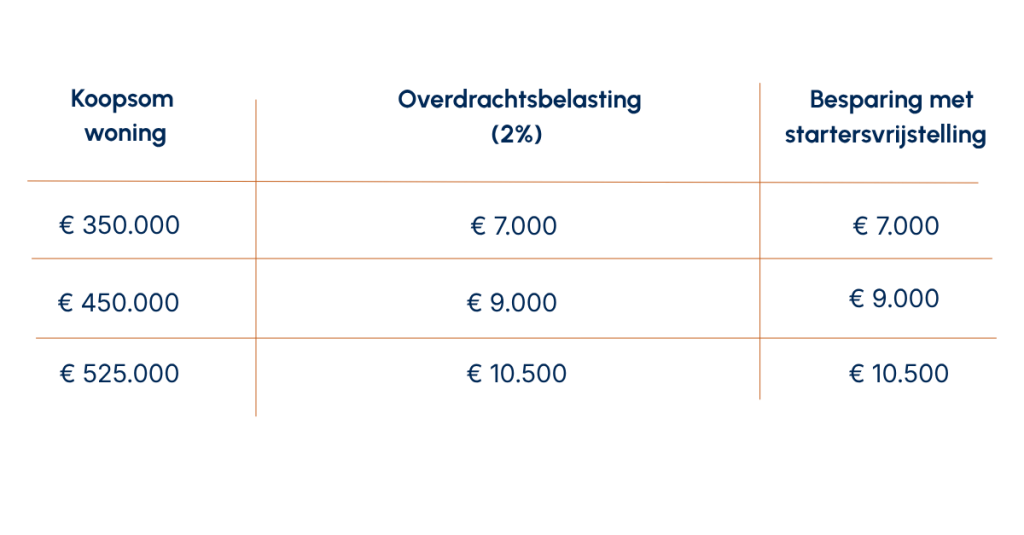
How much could you save?
Here is a examples to put the numbers into perspective:
Is the exemption only for your first home?
This is probably one of the biggest misconceptions. Many people assume you can only qualify if you have never owned a property before. That isn’t the case. The key question is whether you have used the exemption before. If you have owned a home in the past but did not use the exemption at the time, you may still qualify, provided you meet all the other conditions.
Buying together: how does it work?
This is one of the questions we hear most often. If you are buying a property together, the Dutch Tax and Customs Administration (Belastingdienst) assesses each buyer separately.
Situation 1: you are both under 35
Situatie 1: jullie zijn allebei jonger dan 35 jaar
Voldoen jullie allebei aan de voorwaarden? Dan kunnen jullie allebei gebruikmaken van de startersvrijstelling.
Situatie 2: één partner is ouder dan 35 jaar.
Dan kan de jongere partner gebruikmaken van de startersvrijstelling voor zijn of haar aandeel. De oudere partner betaalt over zijn of haar aandeel overdrachtsbelasting.
Do you need to apply for the exemption yourself?
Not exactly. The notary handles the transfer tax declaration. You will, however, need to declare that you meet the conditions and intend to live in the property yourself. Always check that all the information is correct before signing the deed of transfer.

Ben je je nog aan het oriënteren waar je zou willen wonen in Utrecht? Ontdek welke buurt het beste past bij jouw woonwensen.
Does the exemption apply to new-build homes?
When you buy a new-build property, you usually pay VAT rather than transfer tax. This means the first-time buyer exemption generally doesn’t apply. There are exceptions. For example, you might buy a new-build property from a private individual at a later stage because they can no longer complete the purchase. In that case, transfer tax may be due. If you meet the conditions, you may then be able to use the first-time buyer exemption.
Can you save the exemption for later?
You don’t have to use the exemption straight away. In some situations, it may make more financial sense to save it for a future property. Whether that is the right decision depends entirely on your circumstances. Make sure you get proper advice before deciding. You can only use the exemption once, and it is always worth checking the latest rules before buying.
Buying your first home in Utrecht?
The Utrecht property market often moves quickly, with popular homes sometimes selling within just a few days. That makes it even more useful to know which schemes and exemptions you qualify for before you start bidding. Doing your homework beforehand means you can make an offer with a clearer idea of your budget and what is financially possible.
The Utrecht property market often moves quickly, with popular homes sometimes selling within just a few days. That makes it even more useful to know which schemes and exemptions you qualify for before you start bidding. Doing your homework beforehand means you can make an offer with a clearer idea of your budget and what is financially possible.
What else should you consider?
- de kosten koper;
- de Nationale Hypotheek Garantie (NHG);
- je maximale hypotheek;
- hoeveel eigen geld je nodig hebt;
- de voorwaarden die je opneemt in je bod.
You should also think about: